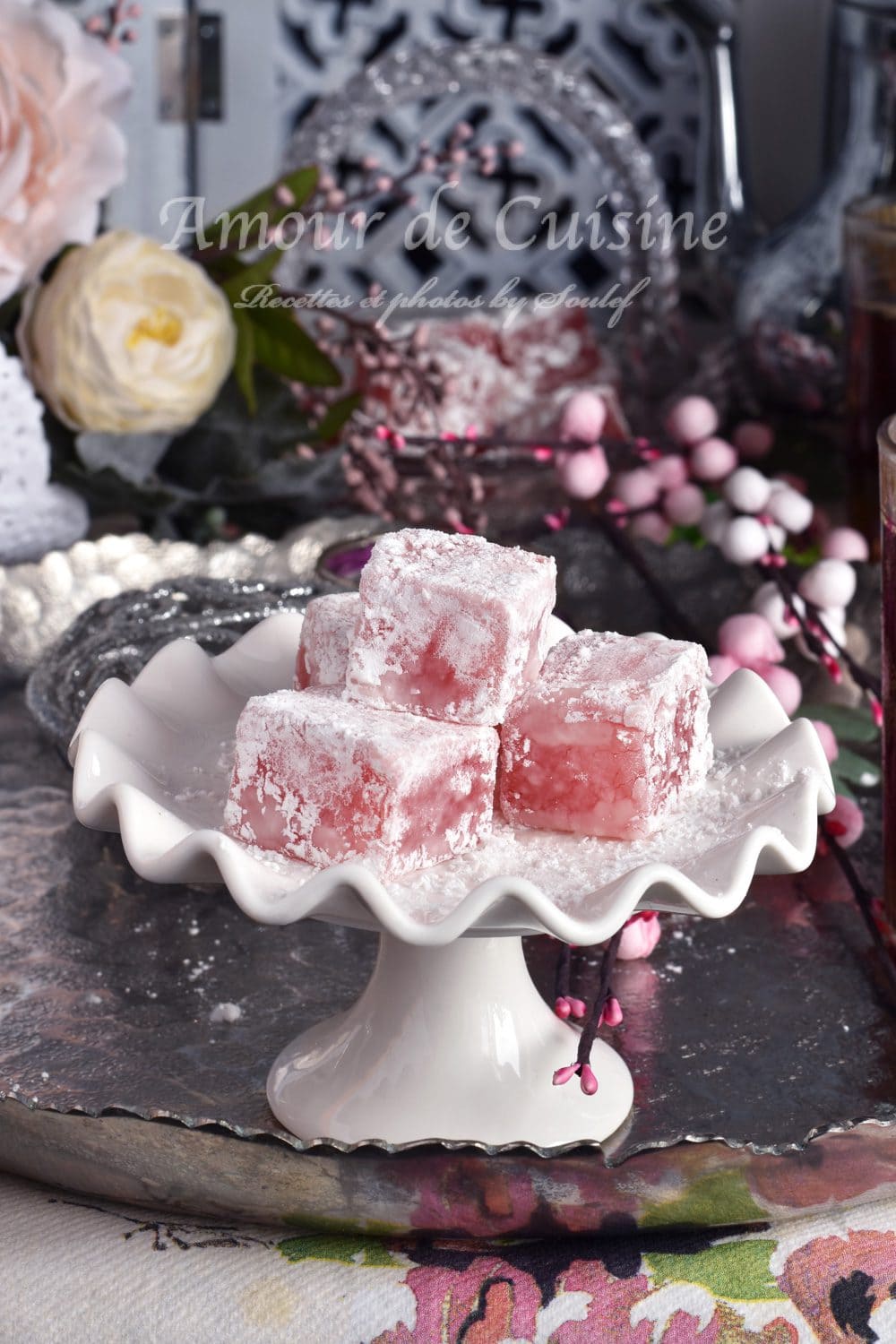
Homemade Turkish Delight (Lokum): Gelatin-Free Recipe

This homemade Turkish delight, or lokum, is soft, delicately chewy and naturally vegan, made with cornstarch instead of gelatin.
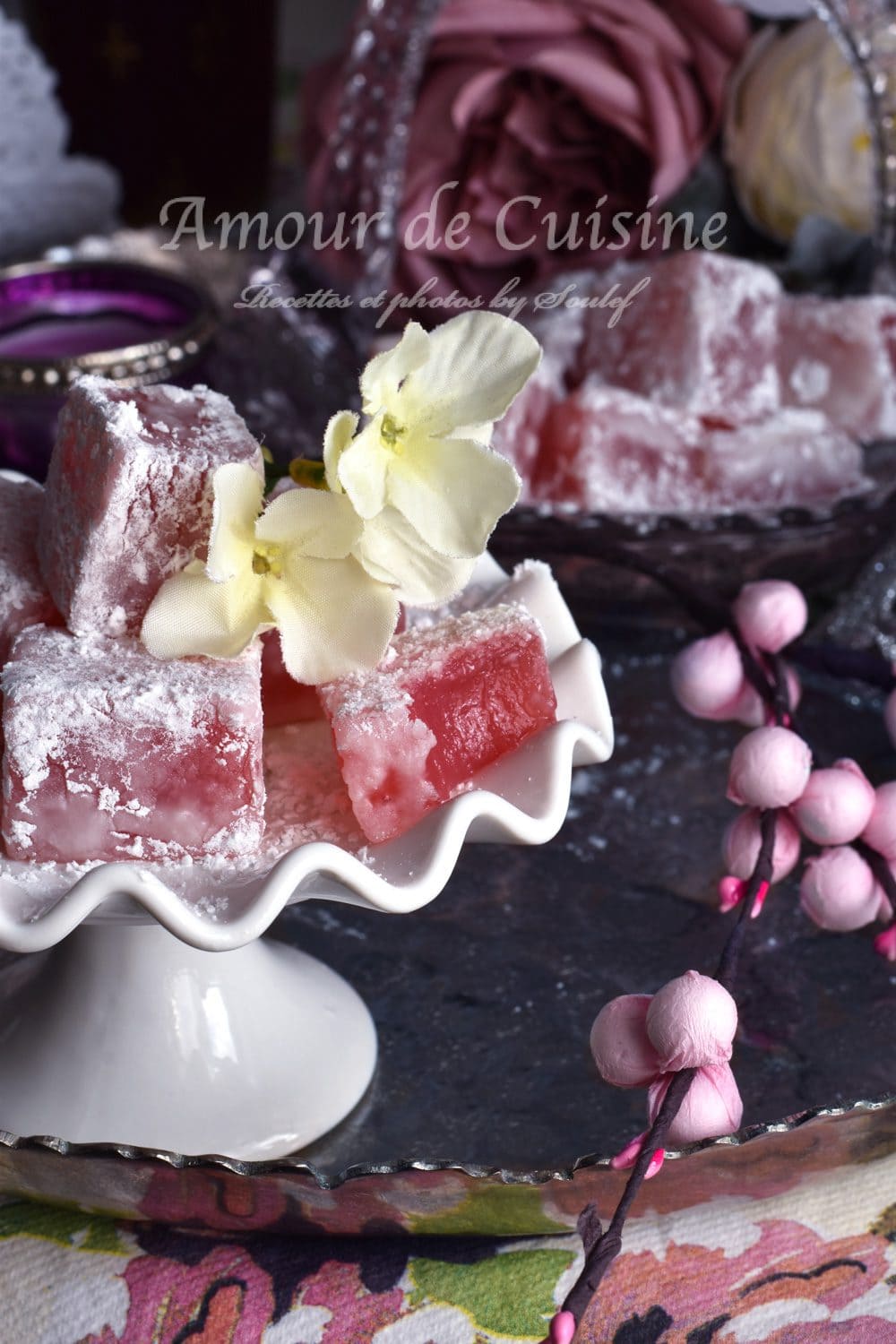
It is scented with rose water, lightly coloured with pomegranate syrup, and dusted with a powdered sugar and cornstarch coating so each piece stays tender and easy to serve.
When I was little, my mother used to make a very simple homemade halkouma- algerian name for lokum- with flavoured sparkling drinks, sometimes orange, lemon or even cola flavor, without adding any extra sugar.
She would thicken it with cornstarch, stirring patiently until it became glossy, soft and slightly chewy.
This Turkish delight recipe reminds me of that family version, but with a more delicate flavour from rose water and a pretty pink colour from pomegranate syrup. It is the kind of sweet I love making at home: nostalgic, fragrant, simple, and made to be shared with tea or coffee.
What is Turkish delight, or lokum?
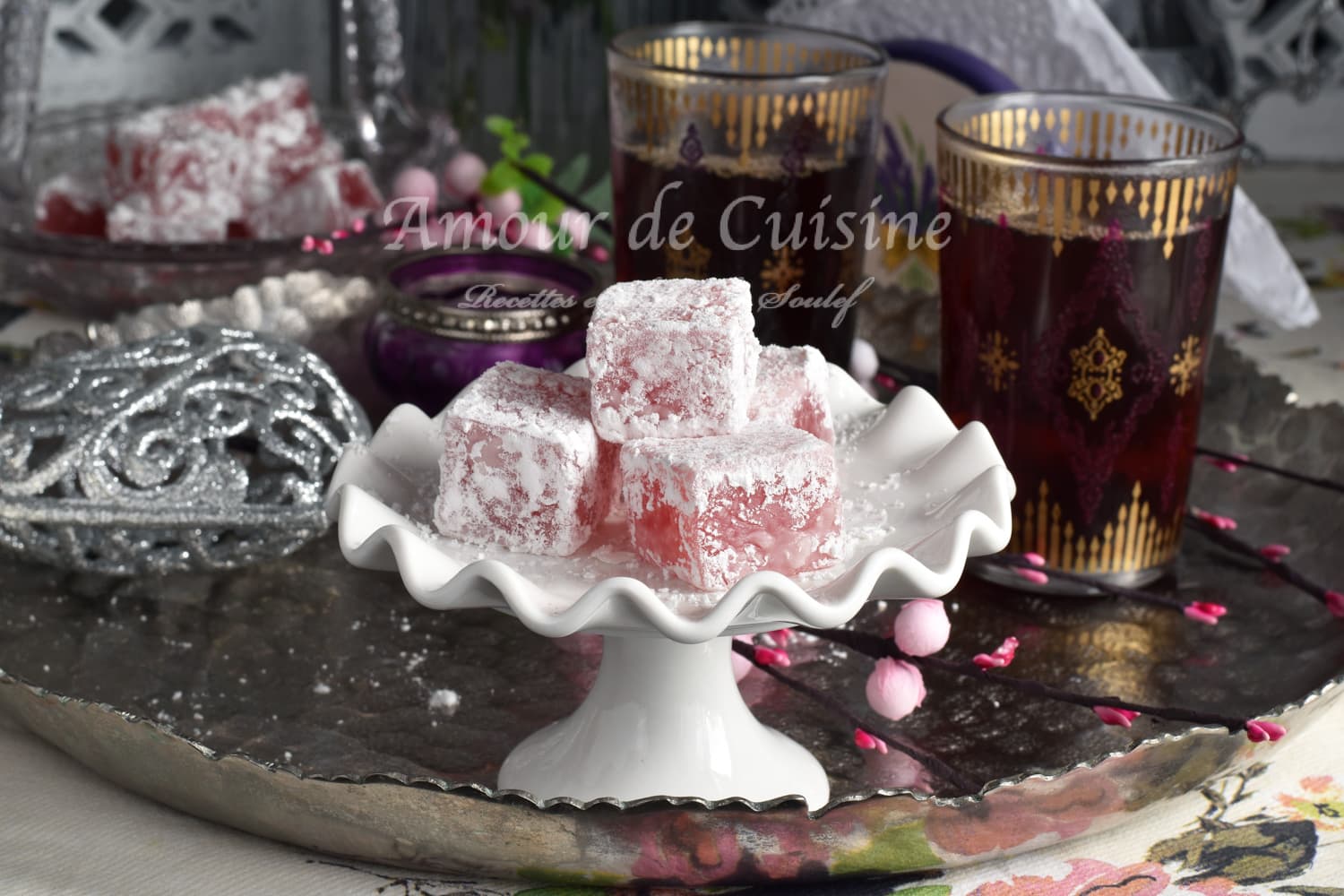
Turkish delight, also called lokum, is a soft sugar-and-starch sweet cut into small cubes and usually coated in powdered sugar. It can be flavoured with rose water, orange blossom water, lemon, pomegranate, pistachios or other nuts.
This version is gelatin-free and uses cornstarch to create the texture. The base recipe is also vegan, as long as the food colouring you use is vegan-friendly.
Why you’ll love this Turkish delight recipe
- Gelatin-free: the texture comes from cornstarch, not gelatin.
- Naturally vegan: the base recipe contains no dairy, eggs or animal gelatin.
- No candy thermometer needed: you judge the mixture by texture.
- Soft and fragrant: rose water gives that classic delicate flavour.
- Pretty pink colour: pomegranate syrup adds a gentle fruity note.
- Personal and homemade: inspired by the halkouma I grew up with.
Ingredients for homemade Turkish delight
- 440 ml water: This is the base of the recipe and helps dissolve the sugar and cornstarch smoothly.
- 280 g sugar: Sugar gives Turkish delight its sweetness, shine and structure. Try not to reduce it too much, as it helps the texture set properly.
- 60 g cornstarch: This is the key ingredient for a gelatin-free Turkish delight. In the UK, cornstarch is often sold as cornflour.
- 1/4 teaspoon salt: A small amount balances the sweetness.
- 1 tablespoon rose water: This gives the Turkish delight its delicate floral flavour.
- 1 tablespoon pomegranate syrup: It adds a soft pink colour and a light fruity note. You can also use grenadine-style syrup if that is what you have.
- Juice of 1/2 lemon: Lemon brightens the flavour and balances the sweetness.
- 1 handful crushed pistachios, optional: Adds a little crunch and makes the pieces look more festive.
- A few drops of red food colouring, optional: Use only if you want a stronger pink colour.
For the coating
- 2 tablespoons powdered sugar: Also called icing sugar in the UK. It helps stop the cubes from sticking.
- 1 tablespoon cornstarch: Mixed with powdered sugar, it keeps the coating lighter and drier.
- A little oil: For greasing the tin and the knife.
How to make gelatin-free Turkish delight
Prepare the tin
- Lightly oil a 20 x 20 cm square tin.
- Line the base with parchment paper.
- Lightly oil the parchment paper too.
- Keep the tin ready before you start cooking, because the hot Turkish delight mixture needs to be poured straight away.
Mix the base before heating
- Add the water, sugar, cornstarch, salt, lemon juice and pomegranate syrup to a heavy-bottomed saucepan.
- Whisk everything together while the mixture is still cold.
- This helps dissolve the cornstarch and prevents lumps.
- Add a few drops of red food colouring if you want a brighter pink Turkish delight.
Cook until thick, glossy and heavy
- Place the pan over medium heat.
- Stir constantly with a whisk at the beginning.
- As the mixture thickens, switch to a wooden spoon or a strong spatula.
- Keep stirring until the mixture becomes very thick, glossy and heavy.
- It should become harder to stir and start pulling slightly away from the bottom of the pan.
This is the most important step. If the mixture is undercooked, the Turkish delight will stay too soft and sticky.
Add the rose water
- Once the mixture is thick and shiny, add the rose water.
- Stir for a few more seconds so the flavour is evenly mixed in.
- I like adding the rose water near the end because the fragrance stays softer and more delicate.
Pour and leave to set
- Pour the hot mixture into the prepared tin.
- Smooth the top with the back of a lightly oiled spoon.
- Leave it to set overnight at room temperature.
- Avoid the fridge, as humidity can make homemade Turkish delight sticky.
Cut and coat
- The next day, mix the powdered sugar and cornstarch in a bowl.
- Sprinkle some of the coating over the top of the Turkish delight.
- Turn the block out onto a surface dusted with more coating.
- Lightly oil a sharp knife.
- Cut into small squares.
- Coat each piece well in the powdered sugar and cornstarch mixture.
My best tips for soft Turkish delight
- Do not rush the cooking: The mixture needs time to become thick, glossy and heavy.
- Whisk before turning on the heat: This simple step prevents cornstarch lumps.
- Stir constantly: Once the mixture thickens, it can catch at the bottom of the pan.
- Do not reduce the sugar too much: Sugar helps the Turkish delight set and gives it that soft, chewy bite.
- Leave it overnight: The texture is much easier to cut the next day.
- Oil the knife before cutting: It makes cleaner cubes and less mess.
- Use plenty of coating: Homemade Turkish delight is naturally a little sticky, so the powdered sugar-cornstarch mixture is essential.
Turkish delight variations
Rose Turkish delight
This is the flavour closest to the recipe shared here. Rose water gives that classic floral note, while pomegranate syrup and optional red colouring give a soft pink colour.
Pomegranate Turkish delight
For a fruitier version, I love this pomegranate Turkish delight (recipe coming soon). It has a deeper fruity flavour and a beautiful colour, perfect if you want to prepare several types of lokum for a sweet platter.
If you translate that recipe into English later, this internal link can point to the English version instead.
Pistachio Turkish delight
Add crushed pistachios at the end of cooking, just before pouring the mixture into the tin. You can also sprinkle them on one side only if you want to keep the Turkish delight very soft with just a little crunch.
Orange blossom Turkish delight
Replace the rose water with orange blossom water for a softer North African-style flavour. This version reminds me of the sweets often served with coffee in Algerian homes.
Turkish delight without food colouring
You can leave out the red colouring. The flavour will stay the same, but the colour will be softer and more natural.
How to store homemade Turkish delight
Store homemade Turkish delight in an airtight container at room temperature, in a dry place. Coat the cubes generously with the powdered sugar and cornstarch mixture before storing them.
I do not keep Turkish delight in the fridge because the moisture can make it sticky. If you are preparing it as a homemade gift, separate the layers with parchment paper and add a little extra coating before closing the box.
How to serve Turkish delight
Turkish delight is lovely with mint tea, black tea, Turkish coffee or Arabic coffee. I also like serving it on a small sweets platter during Ramadan, Eid, or when guests come over for coffee.
You can serve it with other homemade sweets such as baklava or kalb el louz.
Frequently asked questions
Is this Turkish delight recipe gelatin-free?
Yes, this is a gelatin-free Turkish delight recipe. The texture comes from cornstarch, not gelatin.
Is Turkish delight vegan?
This homemade Turkish delight is vegan because it is made with water, sugar, cornstarch, rose water, pomegranate syrup and lemon juice. If you use food colouring, check that your brand is vegan-friendly.
Why is my Turkish delight too soft?
It usually means the mixture needed more cooking. Before pouring it into the tin, it should be thick, glossy, heavy and slightly pulling away from the bottom of the pan.
Why is my Turkish delight sticky?
Turkish delight can become sticky if it is undercooked, not coated well enough, or stored in a humid place. Coat each piece generously with powdered sugar and cornstarch, then keep it in an airtight container at room temperature.
Can I make Turkish delight without rose water?
Yes. You can use orange blossom water, lemon zest, vanilla, pomegranate syrup, or another flavouring you enjoy. Add delicate flavourings near the end of cooking so they do not lose their fragrance.
Can I add nuts?
Yes. Pistachios are especially good in Turkish delight, but you can also use chopped walnuts, almonds or hazelnuts.
Does this taste like Narnia Turkish delight?
It has the same idea of a soft, sweet, rose-scented treat, but this version is more personal and family-style. It is inspired by classic lokum and by the homemade halkouma I grew up with.
Homemade Turkish Delight (Lokum)
- Total Time: 40 minutes
- Yield: 25 pices 1x
Description
Soft, chewy homemade Turkish delight, also known as lokum, made with cornstarch instead of gelatin. This gelatin-free and vegan Turkish delight is delicately flavoured with rose water and pomegranate syrup, then coated in powdered sugar for the perfect tender bite.
Ingredients
For the Turkish Delight
- 440 ml water
- 280 g sugar
- 60 g cornstarch
- 1/4 teaspoon salt
- 1 tablespoon rose water
- 1 tablespoon pomegranate syrup
- Juice of 1/2 lemon
- 1 handful crushed pistachios, optional
- A few drops of red food colouring, optional
For Coating
- 2 tablespoons powdered sugar
- 1 tablespoon cornstarch
- A little oil, for greasing the tin and knife
Instructions
-
Lightly oil a 20 x 20 cm square tin, line it with parchment paper, then oil the parchment paper as well.
-
In a heavy-bottomed saucepan, add the water, sugar, cornstarch, salt, lemon juice and pomegranate syrup.
-
Whisk everything together while the mixture is still cold, until the cornstarch is fully dissolved and there are no lumps.
-
Add a few drops of red food colouring, if using.
-
Place the saucepan over medium heat and cook, stirring constantly. Start with a whisk, then switch to a wooden spoon or strong spatula as the mixture thickens.
-
Continue cooking until the mixture becomes very thick, glossy and heavy. It should be harder to stir and begin to pull slightly away from the bottom of the pan.
-
Stir in the rose water at the end of cooking, then mix for a few more seconds.
-
Pour the hot mixture into the prepared tin and smooth the top with the back of a lightly oiled spoon.
-
Leave to set overnight at room temperature. Do not refrigerate, as moisture can make Turkish delight sticky.
-
The next day, mix the powdered sugar and cornstarch for the coating.
-
Dust the top of the Turkish delight, turn it out onto a well-dusted surface, then cut into small squares with a lightly oiled knife.
-
Coat each piece generously in the powdered sugar and cornstarch mixture before serving or storing.
Notes
The recipe is gelatin-free and vegan, as long as your food colouring is vegan-friendly.
In the UK, cornstarch is usually sold as cornflour.
Do not reduce the sugar too much, as it helps the Turkish delight set properly.
The most important step is cooking the mixture until it becomes thick, glossy and heavy.
Store in an airtight container at room temperature, away from humidity.
Avoid the fridge, because it can make homemade Turkish delight sticky.
- Prep Time: 15 min
- Cook Time: 25 min
Nutrition
- Serving Size: 1 piece
- Calories: 75 kcal
by Soulef