Roast Stuffed Turkey Recipe: Juicy, Flavorful, and Easy to Make

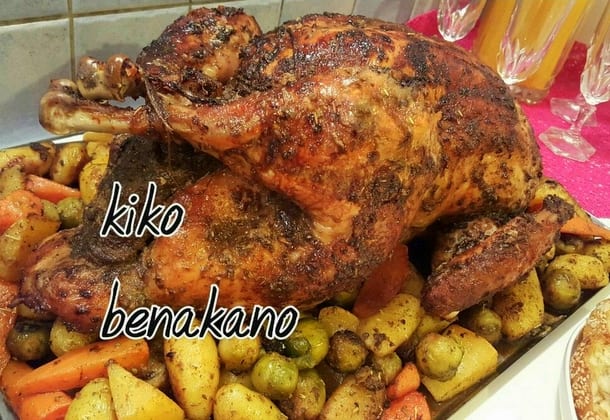
Oven-roasted stuffed turkey is a true centerpiece of festive gatherings.
This traditional, flavorful dish delights with its generous filling, tender meat, and irresistible aroma that brings family and friends together.
Why This Roast Turkey Belongs on Your Holiday Table
Cooking a whole turkey for a special occasion can feel daunting.
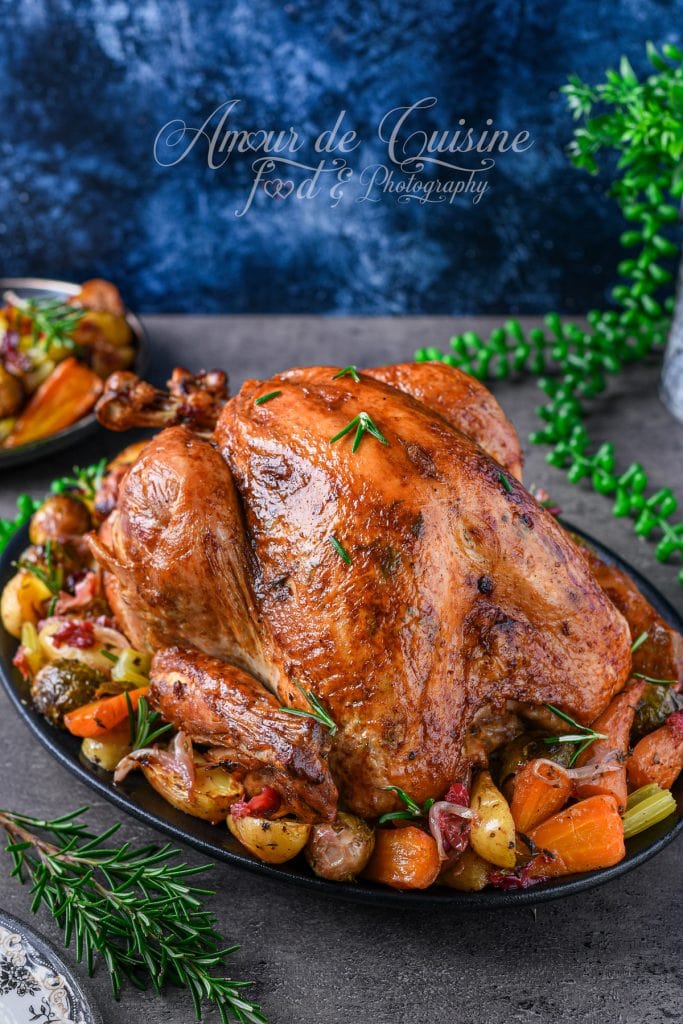
When it’s the centrepiece of Thanksgiving, Christmas or a big family meal, you want it to be perfectly cooked, beautifully golden and full of flavour.
The comforting truth is that this recipe is much simpler than it seems.
At heart, you’re just roasting a large chicken: same basic technique, a little more time, and a few clever tweaks.
With a well-seasoned bird, a flavourful stuffing and a buttery herb rub under the skin, you’ll get tender meat and crisp skin without any fancy equipment.
I’ll guide you step by step, from cleaning and seasoning the turkey, to roasting, basting and resting it so the juices stay inside.
You will find tips for choosing the right size bird.
Follow this guide once, and roasting turkey for a crowd will feel completely manageable, even if you’re not an experienced cook.
I’m planning in a different post to put ideas for different stuffing styles, so don’t forget to follow me !
Ingredients for a Juicy Oven-Roasted Turkey
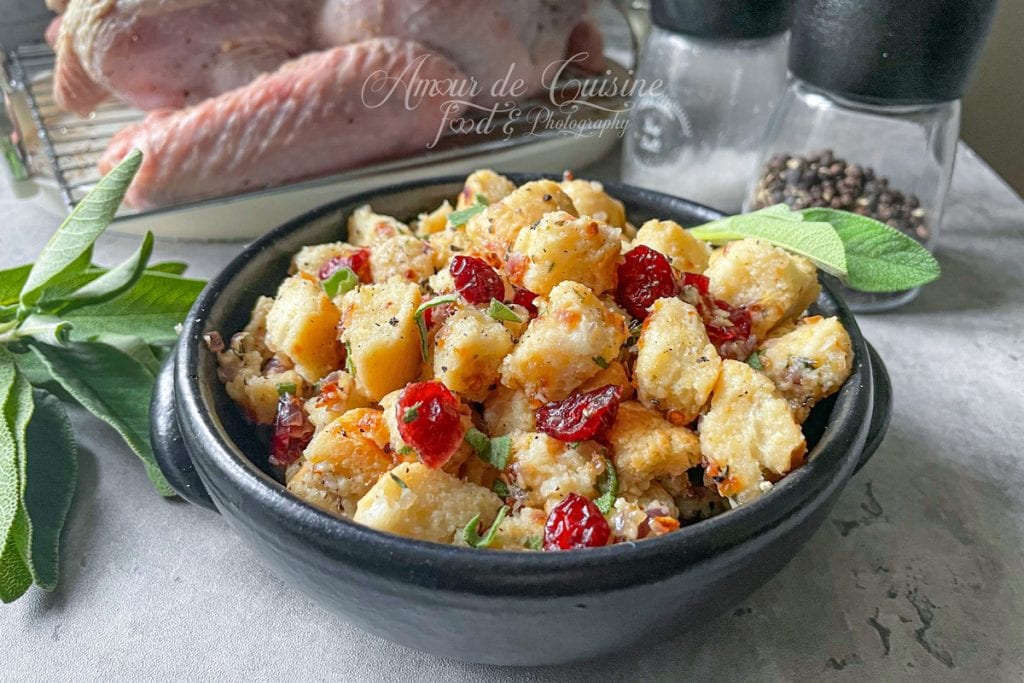
Note: to keep this article focused, I’ll share a separate post dedicated to stuffing recipes for turkey.
For the turkey
- 1 turkey, about 4 kg (around 8–10 people) : Ideal for a family gathering. The larger the bird, the longer it needs to cook. If it was frozen, make sure it is fully thawed before you start.
- Salt and black pepper : The essential base seasoning that wakes up the flavours and penetrates the meat as it cooks.
- Ground cumin : Brings a warm, slightly smoky note that works beautifully with poultry.
- 3-4 garlic cloves : Slip them into the cavity or under the skin for deep, savoury flavour.
- A few sage leaves : An aromatic herb with a fresh, slightly woody taste that feels very festive.
- Extra-virgin olive oil : For rubbing over the skin so it turns golden and crisp in the oven.
For the garlic herb butter (for a 4 kg turkey)
- 100 g unsalted butter, softened : The key to keeping the meat moist and preventing it from drying out. This goes mainly under the skin of the breast.
- 4 garlic cloves, roasted and mashed : Gives a rich, slightly sweet aroma that spreads through the meat as the butter melts.
- Salt and freshly ground black pepper : Adjust to taste for a well-balanced butter.
- A few sage leaves, finely chopped : Their flavour pairs perfectly with the turkey and melted butter.
For the roasted vegetables
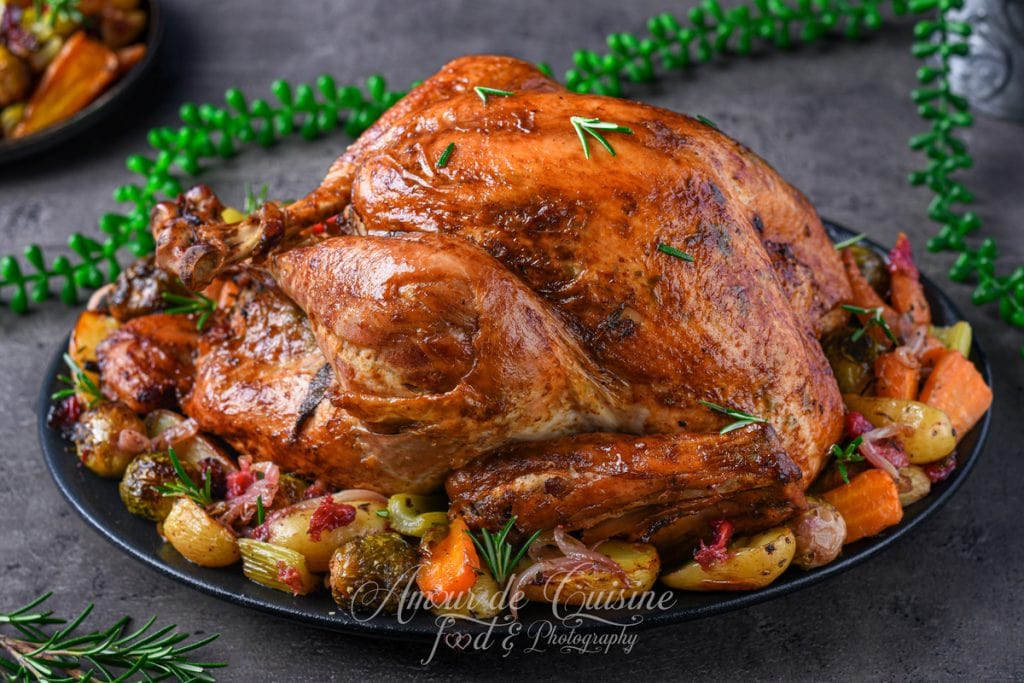
- 250 g Brussels sprouts : They roast beautifully around the turkey and soak up the juices.
- 250 g small potatoes : Their thin skin becomes crisp while the inside stays soft and fluffy.
- 250 g carrots : They add natural sweetness to balance the richness of the turkey.
- 250 g parsnips : A slightly sweet “forgotten” vegetable that is wonderful roasted.
- Garlic, salt and black pepper : Simple but effective seasoning for the vegetables.
- Fresh cranberries (optional) : Bring a tangy note that contrasts nicely with the sweet roasted vegetables.
- Mixed herbs : Thyme, rosemary or parsley, choose your favourites to perfume the vegetables.
- Olive oil : Helps the vegetables caramelise and roast evenly.
Should You Stuff the Turkey?
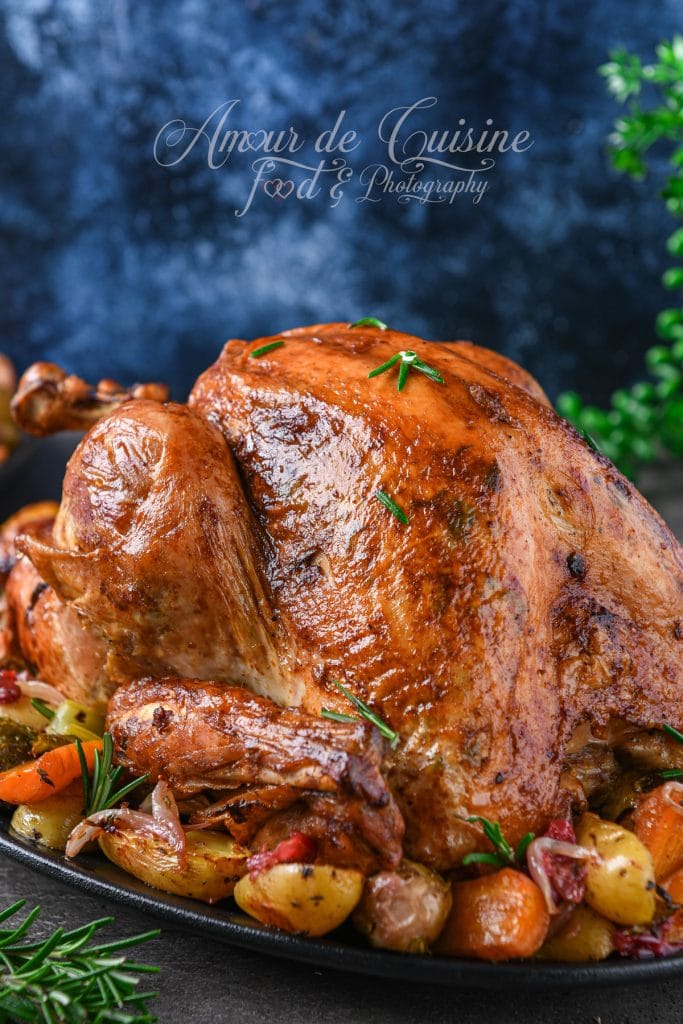
This is completely up to you. Personally, I don’t always stuff my turkey, because my family often prefers their slices served with plenty of vegetables on the side.
If stuffing is part of your holiday tradition, you can definitely do it, just remember to adjust the cooking time.
As a guide, allow about 15 minutes per 450 g (1 lb) of turkey (more details in the roasting guide below).
Keep in mind that the stuffing itself must reach 74°C (165°F) in the centre to be safely cooked, especially if it contains minced meat or turkey giblets.
The tricky part is that the stuffing often takes longer to cook than the turkey, which means you may be tempted to leave the bird in the oven too long and end up with dry meat.
That’s why I often choose not to stuff the cavity, or I prepare a traditional English-style bread stuffing and bake it separately.
I’m not sharing my full stuffing recipe here today, it will have its own dedicated post, so this one doesn’t become too long.
How to Prepare the Turkey (Cleaning & First Seasoning)
I was lucky enough to make this roast stuffed turkey in Algeria, when the whole family gathered to celebrate my eldest son’s birthday. Is easier to buy a turkey in algeria all the year long, not just waiting for christmas to find this bird !
Below I’m sharing all my tips and tricks to help you get a roast turkey with tender, melt-in-your-mouth, juicy meat every time.
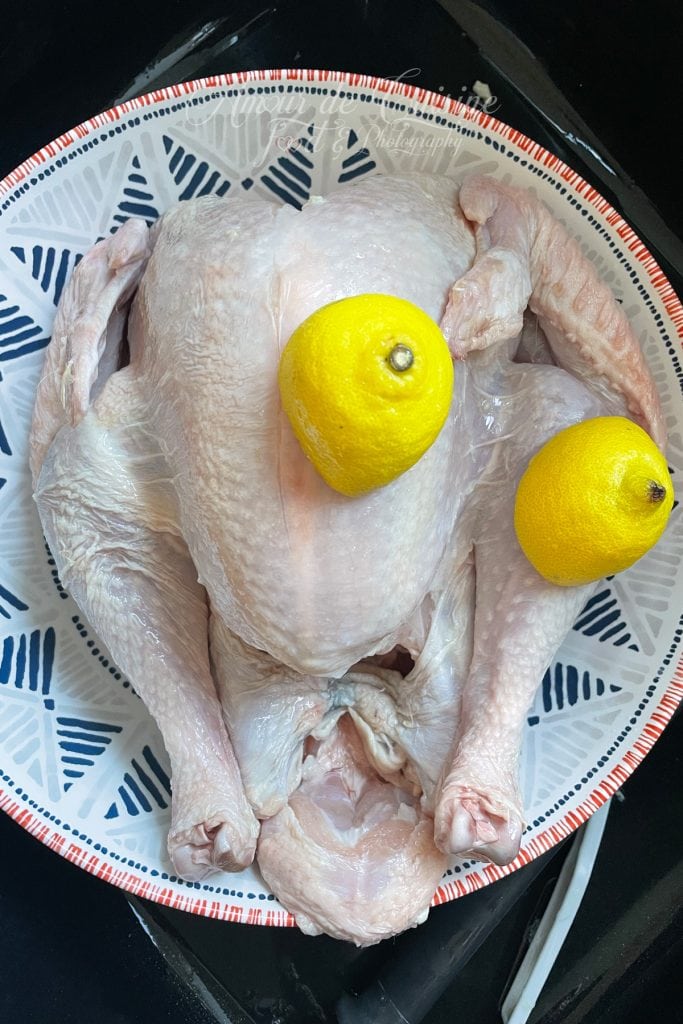
- Clean the turkey thoroughly : Rinse the inside and outside, remove any giblets, and wash the cavity with water mixed with vinegar and lemon juice.
- Dry the turkey well : Pat the inside and outside dry with paper towels. This step is important for crispy skin.
- Rub with lemon : Rub the whole turkey again, inside and out, with cut lemon. This helps with flavour and odour.
- Season generously : Mix black pepper, cumin and salt, then rub this mixture all over the turkey, especially between the skin and the meat wherever you can gently separate it.
- Add garlic and sage : Cut the garlic cloves into slivers and place them inside the cavity along with a few sage leaves.
- Chill and dry : Let the turkey sit in the fridge for at least 6 hours, uncovered if possible, so the skin dries slightly and the seasoning penetrates the meat.
Garlic & Herb Butter: the Secret to Juicy Meat
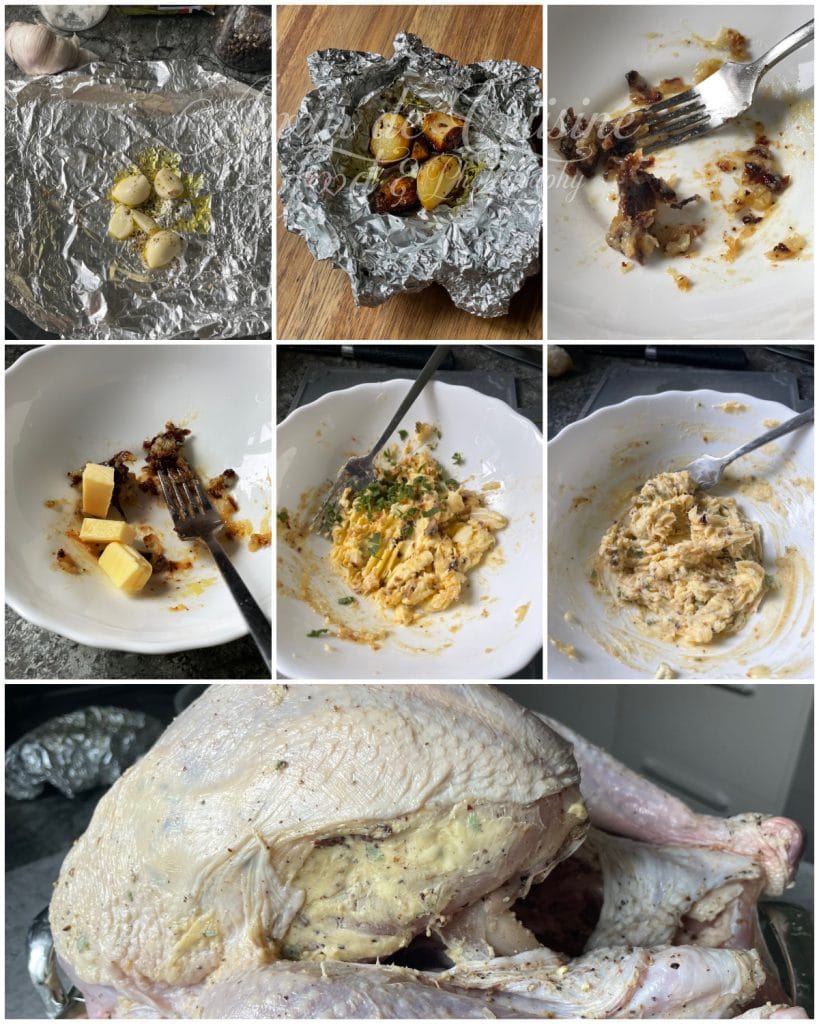
Roast the garlic
- Place the garlic cloves on a small piece of aluminium foil.
- Drizzle with a little olive oil and sprinkle with a pinch of salt and pepper.
- Fold the foil to make a pouch.
- Roast at 180°C / 350°F for about 30 minutes, until the garlic is soft and lightly caramelised.
Make the flavoured butter
- In a bowl, mix the softened butter, the finely chopped sage and the roasted garlic, mashed into a paste.
- Stir until you have a smooth, well-flavoured butter.
Slide the butter under the skin
- Gently loosen the skin over the turkey breast with your fingers, being careful not to tear it.
- Generously spread the garlic herb butter between the skin and the meat.
- Smooth the skin with your hands from the outside to distribute the butter evenly.
This step is what gives you ultra-juicy meat and beautifully golden skin after roasting.
Quick Roasting Guide by Turkey Weight
The most common question is: “How long does it take to roast a turkey?”
Because every bird is a different size, there isn’t one single cooking time, but rather a simple formula.
General rule for an unstuffed turkey: Allow about 15 minutes per 450 g (1 lb) of turkey.
Your turkey may cook a little faster, so start checking the internal temperature about 15 minutes before the estimated time is up.
Approximate roasting times
- 3.6-4.5 kg (8-10 lb): 1 h 45 – 2 h 15
- 5-6 kg (11-13 lb): 2 h 20 – 2 h 50
- 6.3-7.2 kg (14-16 lb): 3 h – 3 h 30
- 7.7-9 kg (17-20 lb): 3 h 40 – 4 h 20
Tip: Always use a meat thermometer. It’s the most reliable way to make sure your turkey is cooked through but still juicy.
Step-by-Step: How to Roast the Turkey
1. Preheat the oven : Preheat your oven to 230°C / 450°F.
This initial high heat helps the skin turn nicely golden.
2. Season and fill the cavity :
- Place in the cavity: one onion, the garlic cloves, 8 sprigs of rosemary and 8 sprigs of sage.
- If you’re using a stuffing, this is the moment to spoon it inside.
- Arrange any remaining herb sprigs in the roasting pan around the turkey to perfume the juices.
3. Add the garlic herb butter & olive oil
- Insert the garlic herb butter under the skin over the breast, as described above. Try to spread it as evenly as possible.
- If you have some butter left, you can also rub a thin layer over the outside of the turkey.
- Personally, because I season the turkey quite generously with salt, pepper and cumin right after cleaning it, I don’t always coat the entire outside with flavoured butter.
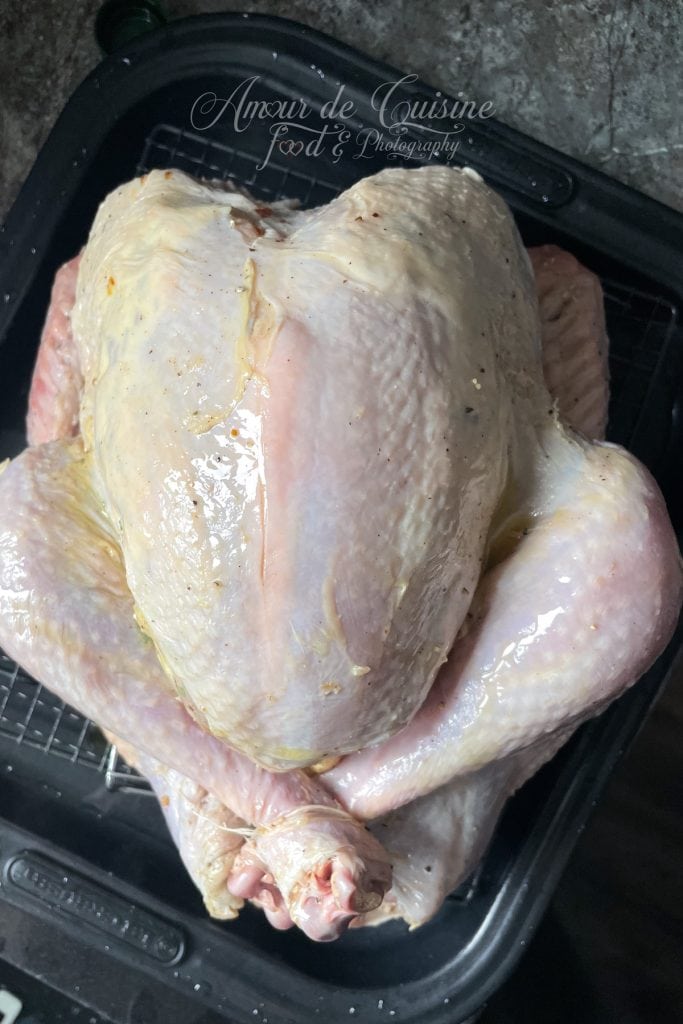
- Finally, rub the whole bird with extra-virgin olive oil. This is what gives you that golden, crisp skin.
4. Tie the legs : For a neat presentation and more even cooking, tie the legs together with kitchen string.
5. Start roasting
- Pour a little water into the bottom of the roasting pan so the drippings don’t burn.
- Place the turkey on a rack in the pan.
- Roast for 15 minutes at 230°C / 450°F.
6. Lower the temperature and continue cooking
- Reduce the oven temperature to 165°C / 325°F.
- Continue roasting, basting every 30 minutes with the pan juices.
- Between bastings, I like to change the position of the turkey for an even golden colour: start breast-up, then turn it onto the left side, then onto the right side, and finish breast-up again. (Use flexible silicone oven gloves to turn the turkey safely.)
- Roast until the thickest part of the thigh reaches 74°C / 165°F on a meat thermometer.
- Count about 2 to 2½ hours in total, or roughly 12 minutes per 450 g (1 lb).
- Add a little more water if the pan starts to dry out.
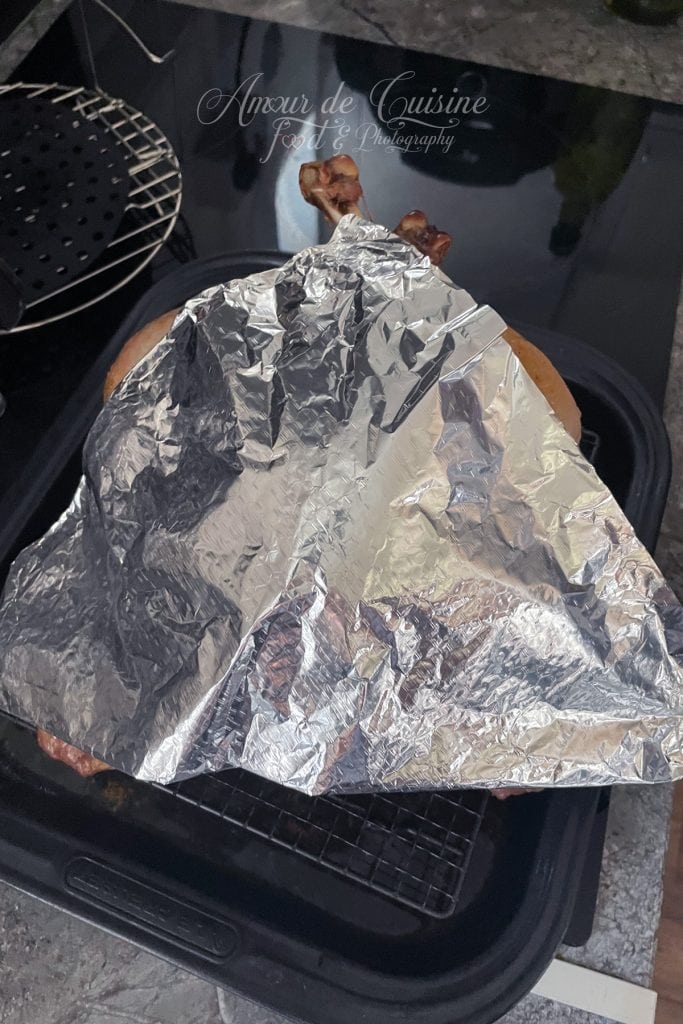
- If the skin on the breast, legs or wings browns too quickly at any point, cover just those areas loosely with foil.
7. Rest the turkey
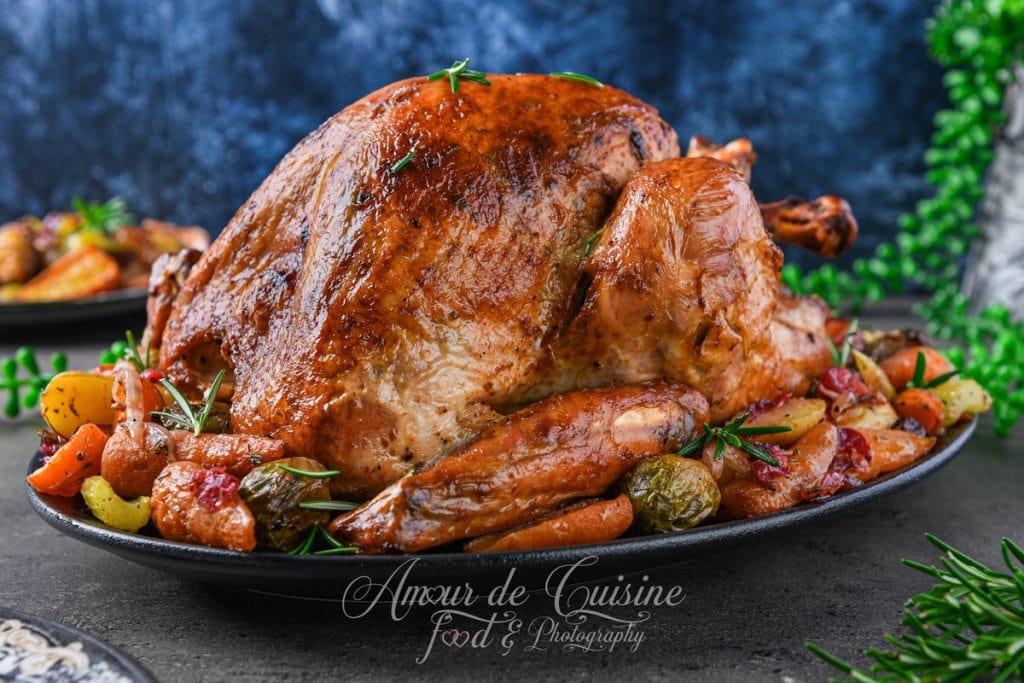
- Remove the turkey from the oven and let it rest in the pan for 15 minutes before carving.
This allows the juices to redistribute, making the meat more tender and moist.
8. Use the pan juices
- Strain the pan juices and serve them as they are, or use them to make a rich, flavourful gravy to serve with the turkey.
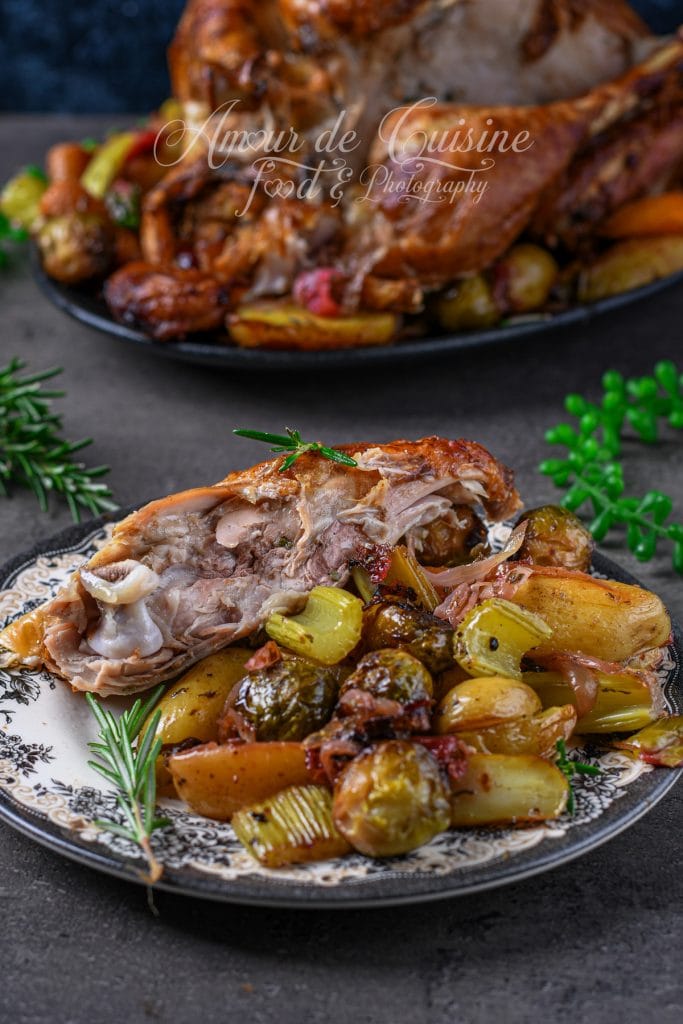
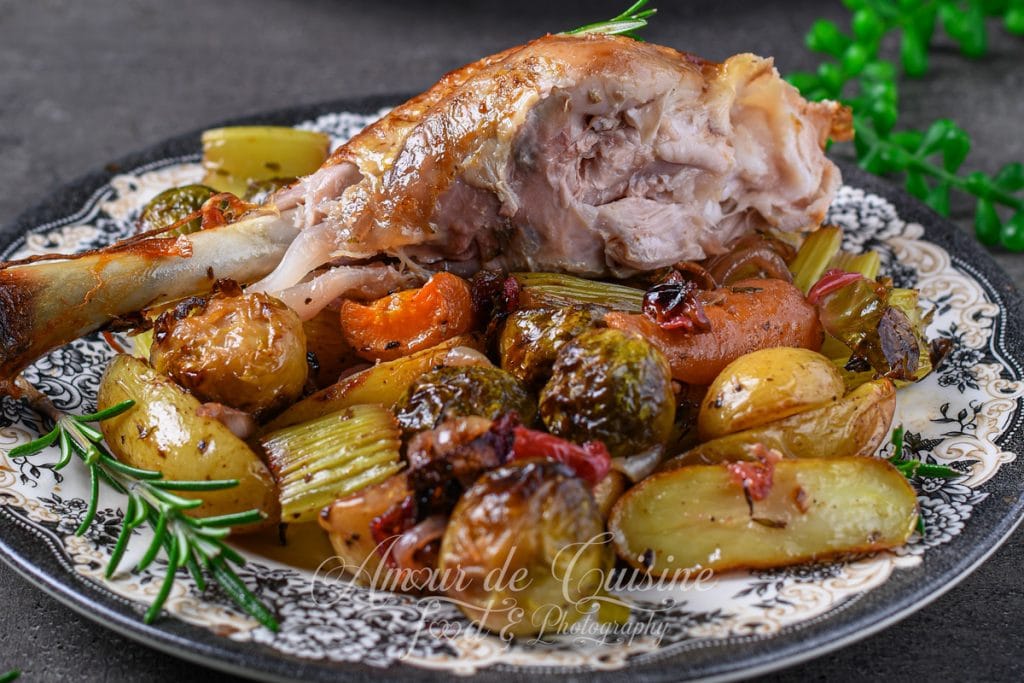
How to Prepare the Roasted Vegetables
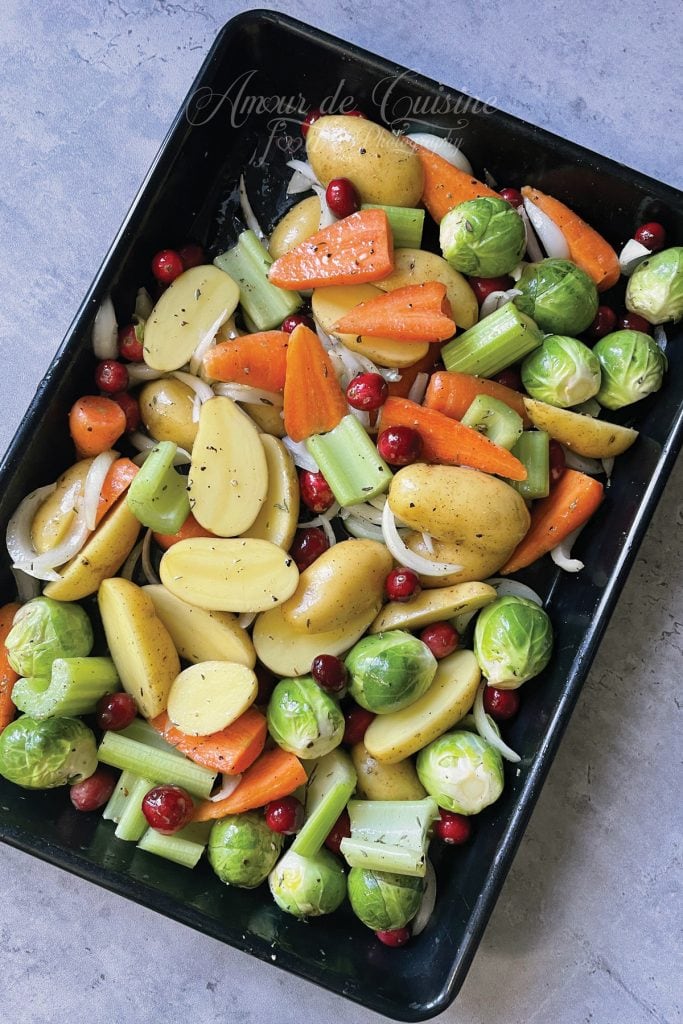
- Parboil the vegetables : Cook each type of vegetable separately in gently salted boiling water for about 5 minutes, no more. This helps them roast evenly without falling apart.
- Season the vegetables : Season the vegetables (either separately or all together) with grated garlic, salt, black pepper and herbes de Provence.
Add olive oil, a little of the vegetable cooking water, and if possible a spoonful of turkey drippings. - Roast in the oven : Place the vegetables in an ovenproof dish, cover with foil and bake for 15 minutes on a rack below the turkey.
- Brown and finish : Remove the foil and continue roasting until the vegetables are nicely golden. At this stage you can add another spoonful of turkey juices for even more flavour.
Stuffing Variations for Roast Turkey
A stuffed turkey can be adapted to different occasions, traditions, and tastes. Here are some delicious variations to try:
- Classic Chestnut Stuffing, Perfect for Christmas, made with chestnuts, onions, celery, and aromatic herbs.
- Mediterranean Stuffing, A blend of olives, sun-dried tomatoes, Herbes de Provence, and a drizzle of olive oil.
- Middle Eastern Stuffing, Fragrant rice with dried fruits (apricots, raisins, dates), almonds, and warm spices.
- Mushroom Stuffing, A mix of sautéed mushrooms, garlic, parsley, and a little bread soaked in broth.
- Vegetarian Stuffing, Quinoa or bulgur combined with seasonal vegetables and fresh herbs for a lighter version.
Side Dish Ideas for the Perfect Roast Turkey
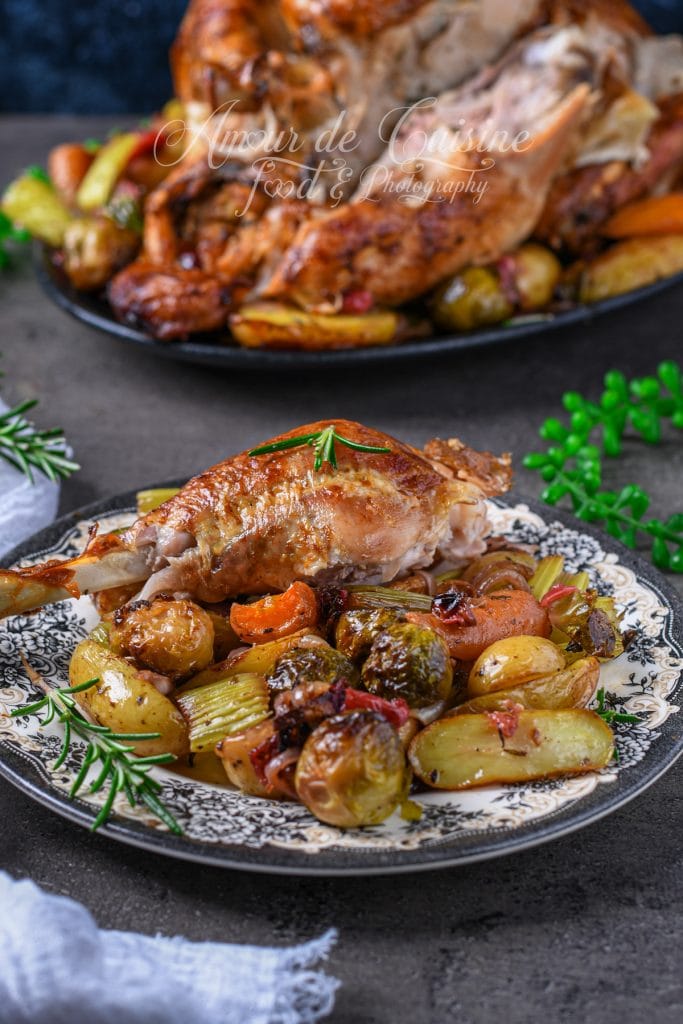
A festive turkey deserves sides that balance flavor, texture, and tradition. Here are some delicious ideas to complete your meal:
- Rosemary Roasted Potatoes, Crispy and aromatic, baked with fresh rosemary.
- Butter-Glazed Vegetables, Carrots, turnips, parsnips, or roasted pumpkin for a sweet, glossy finish.
- Creamy Homemade Mash, Classic mashed potatoes, sweet potato and ginger mash, or rustic crushed potatoes.
- Rich Gravy, Made from pan drippings or deglazed roasting juices to enhance the meat.
- Cranberry Sauce, A tangy, slightly sweet classic that pairs beautifully with turkey.
- Crunchy Fresh Salad, With walnuts and cranberries for a refreshing contrast.
- Brioche or Homemade Dinner Rolls, Soft, warm bread to round out the feast.
What Size Turkey Should You Buy?
The general rule is about 300 g (⅔ lb) of turkey per person if you’re serving light eaters.
For generous portions, or if you’d like leftovers to use in other recipes, plan for 450 g (1 lb) per person.
Keep in mind, these amounts refer to the net meat portion, not including bones. It’s always better to have a little extra than to run short, so here are some helpful guidelines:
- For 8 people: choose a turkey between 3 kg and 3.5 kg (6.5-7.5 lbs)
- For 12 people: choose a turkey between 4 kg and 5.5 kg (9-12 lbs)
- For 16 people: choose a turkey between 6 kg and 7.5 kg (13-16.5 lbs)
Of course, these numbers assume hearty eaters, it’s up to you to adjust based on your guests.
Remember: the total turkey weight includes bones, so the actual meat yield will be less than the listed weight.e, si vous êtes nombreux, prévoyez deux dindes moyennes, ça va être plus facile à cuisiner!
How to Cook a Frozen Turkey
Don’t forget to thaw your turkey first!
One of the biggest mistakes people make is buying a frozen turkey the day before cooking it. Don’t do that, large turkeys take time to defrost properly.
A good rule of thumb: it takes about 24 hours in the refrigerator for every 3 kg (6-7 lbs) of turkey.
Plan ahead: buy your turkey at least a week in advance. Place it in the fridge 2-4 days before the big day so it has plenty of time to thaw safely.
Other roasts to try
- Roast Leg of Lamb : Tender & Juicy
- Slow oven-braised lamb shanks
- Oven-Baked Clementine Glazed Salmon
Step-by-Step Roast Stuffed Turkey Recipe (Juicy and Easy to Make)
- Total Time: 3 hours 45 minutes
- Yield: 10 portions 1x
Description
How to Successfully Roast a Stuffed Turkey in the Oven for Tender Meat and the Perfect Christmas Dinner Centerpiece.
Ingredients
For the turkey
- 1 turkey, about 4 kg (around 8–10 people)
- Salt and black pepper
- Ground cumin
- 3–4 garlic cloves
- A few sage leaves
- Extra-virgin olive oil
For the garlic herb butter (for a 4 kg turkey)
- 100 g unsalted butter, softened
- 4 garlic cloves, roasted and mashed
- Salt and freshly ground black pepper
- A few sage leaves, finely chopped
For the roasted vegetables
- 250 g Brussels sprouts
- 250 g small potatoes
- 250 g carrots
- 250 g parsnips
- Garlic, salt and black pepper
- Fresh cranberries (optional)
- Mixed herbs
- Olive oil
Instructions
prepare de Garlic & Herb Butter
- Place the garlic cloves on a small piece of aluminium foil.
- Drizzle with a little olive oil and sprinkle with a pinch of salt and pepper.
- Fold the foil to make a pouch.
- Roast at 180°C / 350°F for about 30 minutes, until the garlic is soft and lightly caramelised.
- In a bowl, mix the softened butter, the finely chopped sage and the roasted garlic, mashed into a paste.
- Stir until you have a smooth, well-flavoured butter.
- Gently loosen the skin over the turkey breast with your fingers, being careful not to tear it.
- Generously spread the garlic herb butter between the skin and the meat.
- Smooth the skin with your hands from the outside to distribute the butter evenly.
Cook the turkey
- Preheat your oven to 230°C / 450°F.
- Season and fill the cavity : Place in the cavity: one onion, the garlic cloves, 8 sprigs of rosemary and 8 sprigs of sage. If you’re using a stuffing, this is the moment to spoon it inside.
- Arrange any remaining herb sprigs in the roasting pan around the turkey to perfume the juices.
- Insert the garlic herb butter under the skin over the breast. Try to spread it as evenly as possible. If you have some butter left, you can also rub a thin layer over the outside of the turkey.
- Finally, rub the whole bird with extra-virgin olive oil. This is what gives you that golden, crisp skin.
- For a neat presentation and more even cooking, tie the legs together with kitchen string.
- Pour a little water into the bottom of the roasting pan so the drippings don’t burn.
- Place the turkey on a rack in the pan.
- Roast for 15 minutes at 230°C / 450°F.
- Lower the temperature and continue cooking Reduce the oven temperature to 165°C / 325°F.
- Continue roasting, basting every 30 minutes with the pan juices. Between bastings, I like to change the position of the turkey for an even golden colour: start breast-up, then turn it onto the left side, then onto the right side, and finish breast-up again. (Use flexible silicone oven gloves to turn the turkey safely.)
- Roast until the thickest part of the thigh reaches 74°C / 165°F on a meat thermometer.
- Count about 2 to 2½ hours in total, or roughly 12 minutes per 450 g (1 lb).
- Add a little more water if the pan starts to dry out.
- If the skin on the breast, legs or wings browns too quickly at any point, cover just those areas loosely with foil.
- Rest the turkey, remove the turkey from the oven and let it rest in the pan for 15 minutes before carving.
This allows the juices to redistribute, making the meat more tender and moist. - Use the pan juices, strain the pan juices and serve them as they are, or use them to make a rich, flavourful gravy to serve with the turkey.
How to Prepare the Roasted Vegetables
- Parboil the vegetables : Cook each type of vegetable separately in gently salted boiling water for about 5 minutes, no more. This helps them roast evenly without falling apart.
- Season the vegetables : Season the vegetables (either separately or all together) with grated garlic, salt, black pepper and herbes de Provence.
Add olive oil, a little of the vegetable cooking water, and if possible a spoonful of turkey drippings. - Roast in the oven : Place the vegetables in an ovenproof dish, cover with foil and bake for 15 minutes on a rack below the turkey.
- Brown and finish : Remove the foil and continue roasting until the vegetables are nicely golden. At this stage you can add another spoonful of turkey juices for even more flavour.
- Prep Time: 15 minutes
- Cook Time: 3 hours 30 minutes
- Category: main dish
Nutrition
- Serving Size: 1 portion
- Calories: 450 kcal